
Autonomous Driving Truck Business

About Autonomous Trucks
Why Autonomous Trucks Are Needed
The logistics industry is facing increasingly serious transportation challenges, including a shortage of drivers, an aging workforce, reduced long-haul transportation capacity due to stricter labor regulations, and transportation shortages following regulatory reforms.
Advanced Smart Mobility is working to enhance truck transportation through autonomous driving technologies, aiming to realize a sustainable logistics infrastructure.
Key Challenges Facing the Logistics Industry
 Driver shortages and an aging workforce
 Long working hours and demanding working conditions
 Reduction of CO2 emissions
 Reduction of accidents and human error
Advanced Smart Mobility's Challenge
By leveraging autonomous driving technologies to improve truck transportation, Advanced Smart Mobility aims to establish a sustainable logistics infrastructure.
Autonomous Truck Initiatives
Major Projects in the Shin-Tomei Expressway Demonstration Program
Advanced Smart Mobility has participated in autonomous truck demonstration projects on the Shin-Tomei Expressway, including the "RoAD to the L4" Theme 3 Project and truck platooning demonstrations. Through these initiatives, the company has contributed to government-led efforts by the Ministry of Economy, Trade and Industry (METI) and the Ministry of Land, Infrastructure, Transport and Tourism (MLIT), including demonstrations aimed at the social implementation of truck platooning and the verification of technologies and operational methods required for Level 4 autonomous trucks.
"RoAD to the L4" Theme 3 Project(Single-Vehicle Operation)
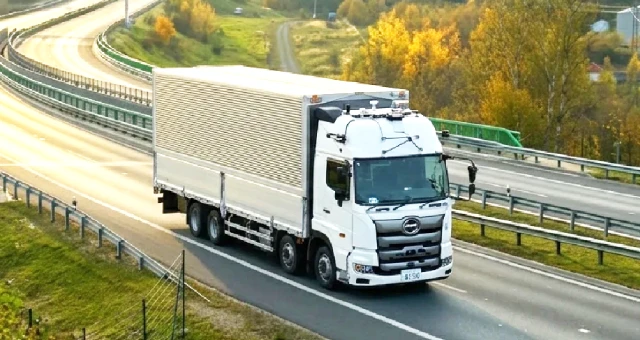
The Theme 3 Project is an initiative aimed at achieving autonomous truck operation on expressways without convoy formation. The project verifies the technologies and operational methods required for Level 4 autonomous driving, contributing to the development of safe and efficient next-generation logistics.
Overview of the Shin-Tomei Expressway Demonstration
| Route | Designated section of the Shin-Tomei Expressway (between Shin-Gotemba IC and Okazaki SA) |
| Vehicle Configuration | Trucks equipped with Level 2 advanced driver assistance systems (used to simulate practical Level 4 operations) |
| Driving Control | Lane keeping based on traffic flow and automatic overtaking control when vehicle speed decreases |
| Objective | Verification of safety and on-time performance for future Level 4 autonomous operation in trunk-line freight transport |
Verification Results
| Safety | Confirmed the ability to respond to sudden cut-ins by surrounding vehicles and road debris through vehicle-road cooperative systems and other technologies |
| Traffic Flow | Maintained average cruising speed and achieved punctuality comparable to conventional manual driving |
| Fuel Efficiency | Confirmed a trend toward improved fuel economy through automated control that minimized unnecessary acceleration and deceleration |
Platooning Technology
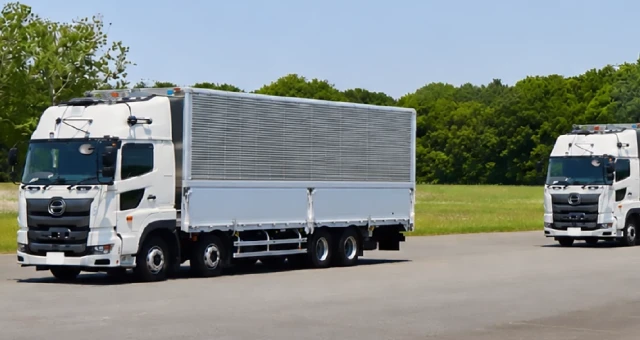
Platooning is a system in which multiple trucks travel in a formation, maintaining a set distance between vehicles, using autonomous driving technology. It aims to build a sustainable logistics system by enhancing efficiency, reducing labor requirements, and improving fuel economy.
Overview of the Shin-Tomei Expressway Demonstration
| Route | Between Hamamatsu SA and Enshu-Morimachi PA on the Shin-Tomei Expressway (both directions) |
| Vehicle Configuration | Lead vehicle with a driver; second and third vehicles operated without drivers in the driver's seat (support personnel seated in the passenger seat) |
| Vehicle Spacing | 5 meters within service and parking areas; 9 meters on the main roadway |
| Objective | Verification of safety, fuel efficiency, and traffic impact for future driverless-following platoon operations |
Verification Results
| Safety | Successfully completed operations safely without incidents |
| Traffic Flow | Vehicle spacing control of 5–10 meters eliminated congestion caused by cut-ins and sudden braking |
| Fuel Efficiency | Confirmed fuel-saving benefits through autonomous driving |
Technology and Systems
Advanced Smart Mobility's Core Technologies
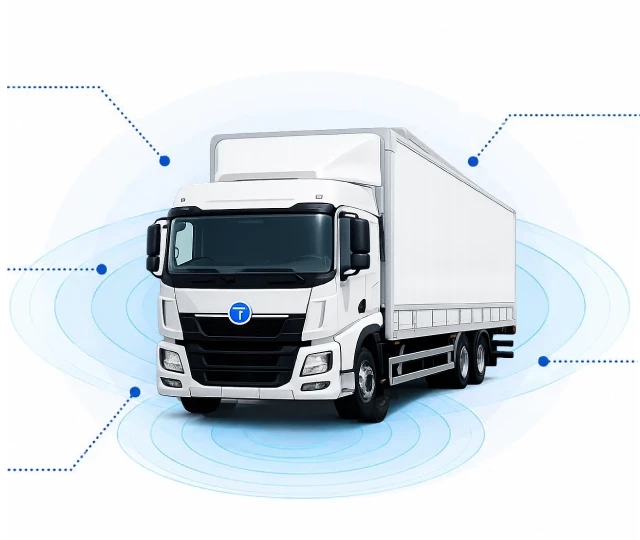
The following core technologies support Advanced Smart Mobility's autonomous truck operations.

Surrounding Environment Recognition Technology
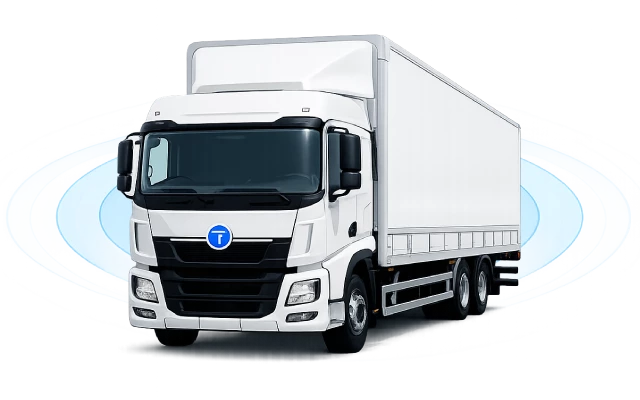
Combines multiple sensors—including LiDAR, cameras, and millimeter-wave radar—to accurately recognize the surrounding environment in all directions.

High-Definition Maps and GNSS
Utilizes high-definition maps (dynamic maps) and GNSS (GPS) to accurately estimate vehicle position while driving.

Autonomous Driving Control Technology
Based on perception data, the system precisely controls lane keeping, acceleration, deceleration, and lane changes to ensure safe and smooth driving.

Fail-Safe Functions
If an abnormality is detected, the vehicle is equipped with fail-safe functionality that quickly brings it to a stop in a safe location.

Remote Operation Monitoring and Management System
Vehicle status is monitored remotely, allowing operators to provide operational support and management when necessary.
Benefits of Autonomous Trucks
Replacement scheme
Operational Efficiency
Optimized transportation planning and stable autonomous operation improve load utilization and reduce logistics costs.
Reduced Driver Burden
Autonomous operation reduces the strain of long-distance and nighttime driving, helping improve working conditions and support workforce recruitment and retention.

Improved Safety
By reducing human error and utilizing advanced sensing technologies, autonomous trucks significantly lower accident risks.

Reduced Environmental Impact
Improved fuel efficiency and reduced CO2 emissions contribute to more sustainable logistics operations.