
Autonomous Driving Bus Business

About Autonomous Buses
True Autonomous Buses: “Driving Automatically” Is Not Synonymous With “Practical Implementation”
The goal of autonomous buses is not simply to “drive automatically.”
Advanced Smart
Mobility aims to achieve truly practical autonomous driving that can operate safely and
continuously within real-world regional transportation environments.
By integrating
multiple technologies, we establish the reliability and operational capability required
for mobility services, delivering practical autonomous buses, including large-scale
buses and unmanned buses.
Ensuring Reliability Through the Integration of Multiple Technologies
-
Magnetic Markers + RTK-GPS
Highly accurate positioning with built-in redundancy -
LiDAR + Cameras + AI
Enhanced recognition accuracy through multi-layered sensing -
V2X Communication
Enhanced safety through infrastructure coordination -
Precision Docking Control
Centimeter-level stopping accuracy
Technology & System Details
Safe Driverless Operation Through the Integration of Multiple Advanced Technologies
Advanced Smart Mobility’s autonomous buses utilize an integrated system combining multiple
cutting-edge technologies.
By designing sensing, AI-based recognition, precise
positioning, infrastructure coordination, and vehicle control as a unified system, we
achieve safe and smooth driverless operation.
Magnetic Marker Technology (Core Technology)
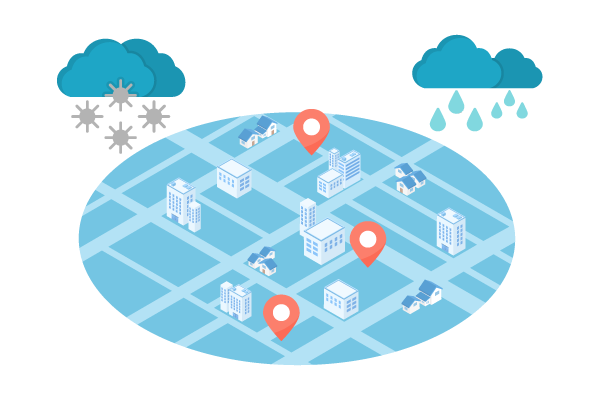
By combining magnetic markers with RTK-GPS, the system achieves centimeter-level positioning accuracy. Because it is less affected by weather and environmental conditions and can be introduced easily onto existing roads, it serves as a stable foundation for autonomous driving operations.
- ○High-precision positioning: Centimeter-level location accuracy
- ○All-weather capability: Maintains performance in rain, snow, and fog
- ○Redundant design: Backup functionality during GPS disruptions
- ○ Retrofit installation: Easy implementation on existing roads
Recognition Functions (Multi-Layered Sensing)
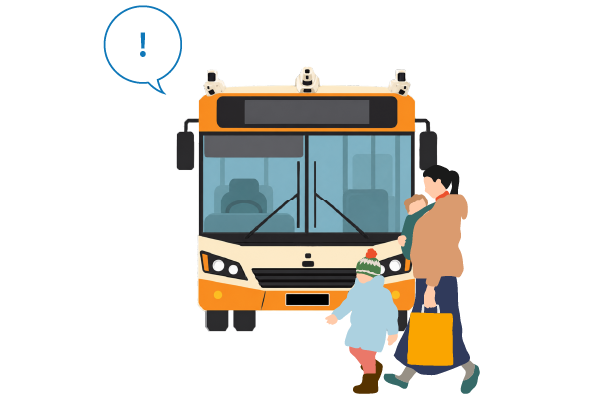
By integrating multiple sensors—including LiDAR, cameras, and millimeter-wave radar—the system detects surrounding pedestrians, vehicles, and obstacles with high precision. Combined with AI-based recognition and prediction technologies, the system supports safe decision-making even in complex traffic environments.
- ○LiDAR: Distance and shape recognition using 3D point cloud data
- ○AI cameras: Object classification and behavior prediction through deep learning
- ○Millimeter-wave radar: Reliable object detection in adverse weather conditions
- ○Lane position determination: High-precision judgment utilizing digital maps
V2X Communication & Traffic Signal Integration
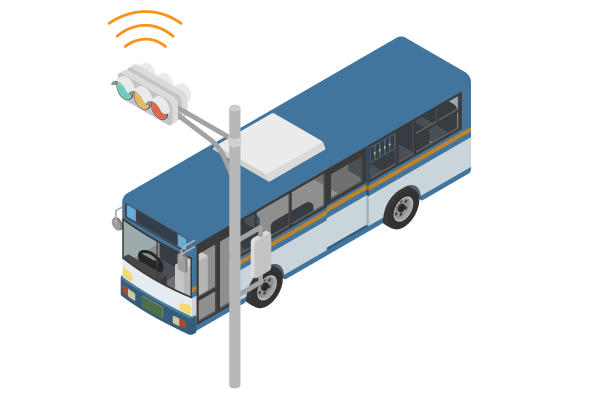
Using V2X technology, which enables communication between vehicles and infrastructure, the system shares traffic signal information and surrounding conditions to further enhance safety. This enables autonomous driving not only as independent vehicle operation, but also as a comprehensive transportation system incorporating operational management and cooperative control.
- ○Predictive control: Avoidance of sudden and unnecessary braking
- ○Smooth traffic flow: Accident prevention, congestion reduction, and energy savings
- ○Visibility-independent safety: Reliable operation unaffected by obstacles or weather conditions
- ○Traffic flow optimization: Positive impact on overall transportation systems
Core Driving Functions
The system precisely controls steering, acceleration, deceleration, and stopping to provide smooth and comfortable ride quality. Through fail-safe design, the vehicle can safely decelerate and stop during abnormalities or emergencies, ensuring the operational quality required for public transportation services.
- ○Autonomous driving contro: High-precision steering and speed control
- ○ACC functionality: Adaptive cruise control with front vehicle following
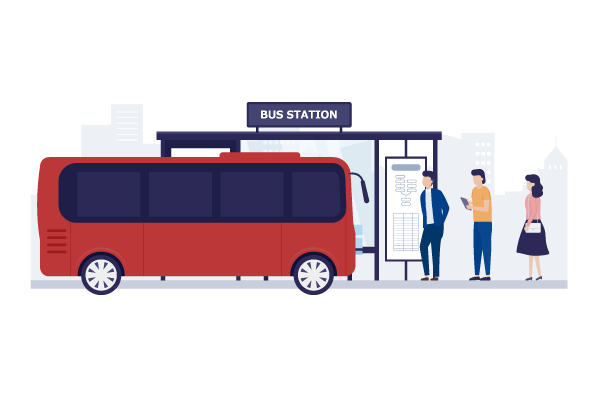
- ○Precision docking control: Accurate bus stop docking using RTK-GPS
- ○Safe stopping: Smooth stopping and departure at designated locations
Autonomous Bus Demonstration
Experiment Case Studies
Hitachi BRT Commercial Operation (Japan’s Longest Commercial Autonomous Bus Route, 6.1 km)
Achieving and Sustaining Japan’s First Level 4 Commercial Operation
Advanced Smart Mobility has achieved Level 4 commercial autonomous bus operation on one of the longest BRT routes in Japan and continues to accumulate operational experience through ongoing service. While maintaining the punctuality and safety required for daily public transportation, we are advancing social implementation as a new model case for regional mobility.
Commercial Operation Achievements
- ○Service operation: Ongoing from 2020 to the present
- ○Operational distance: 6.1 km (longest commercial autonomous bus route in Japan)
- ○Safety record: Continuous accident-free operation
- ○Usage results: Established as an everyday transportation service for local residents
Technical Demonstration Details
- ○Magnetic marker system: Installation and operation across the 6.1 km route
- ○Traffic signal integration: Predictive control at intersections
- ○Unmanned operation: Safe operation equivalent to Level 4 autonomy
Kashiwa-no-ha Demonstration (First Mixed-Traffic Space in the Tokyo Metropolitan Area)
First Mixed-Traffic Level 4 Demonstration in the Tokyo Metropolitan Area
We are conducting Level 4 demonstration experiments in a complex urban environment within the Tokyo metropolitan area, where pedestrians and general traffic coexist. By refining recognition and decision-making accuracy in high-traffic environments, we are advancing technical validation toward the practical implementation of autonomous buses in urban areas.
Technical Challenges Unique to Urban Environments
- ○Mixed traffic: Coexistence with passenger vehicles, pedestrians, and bicycles
- ○Complex intersections: Responding to traffic flows from multiple directions
- ○High-density environments: Safe operation within limited road space
Demonstration Results
- ○Safety: Verified safe operation in mixed-traffic environments
- ○Convenience: Confirmed efficient connectivity with commercial facilities and stations
- ○Technical adaptation: Customized technologies for urban operating environments
- ○Public acceptance: Confirmed high user satisfaction and social acceptance
Practical Deployment in Restricted Areas and Special Operating Environments
Real-World Operation on the Kesennuma BRT
Advanced Smart Mobility has implemented real-world autonomous bus operations on the BRT (Bus Rapid Transit) system developed following the Great East Japan Earthquake. By utilizing dedicated bus lanes, we have achieved stable autonomous operation suitable for continuous regional transportation service, establishing the reliability and safety required for everyday public use. Rather than remaining limited to demonstration testing, these initiatives promote the social implementation of autonomous driving technologies through operation as actual public transportation services.
- ○Stable autonomous operation utilizing dedicated roadway environments
- ○Continuous regional transportation service with maintained schedule reliability
- ○Operational design and safety management integrated with transportation infrastructure
- ○Verification of reliability and redundancy through real-world operation
